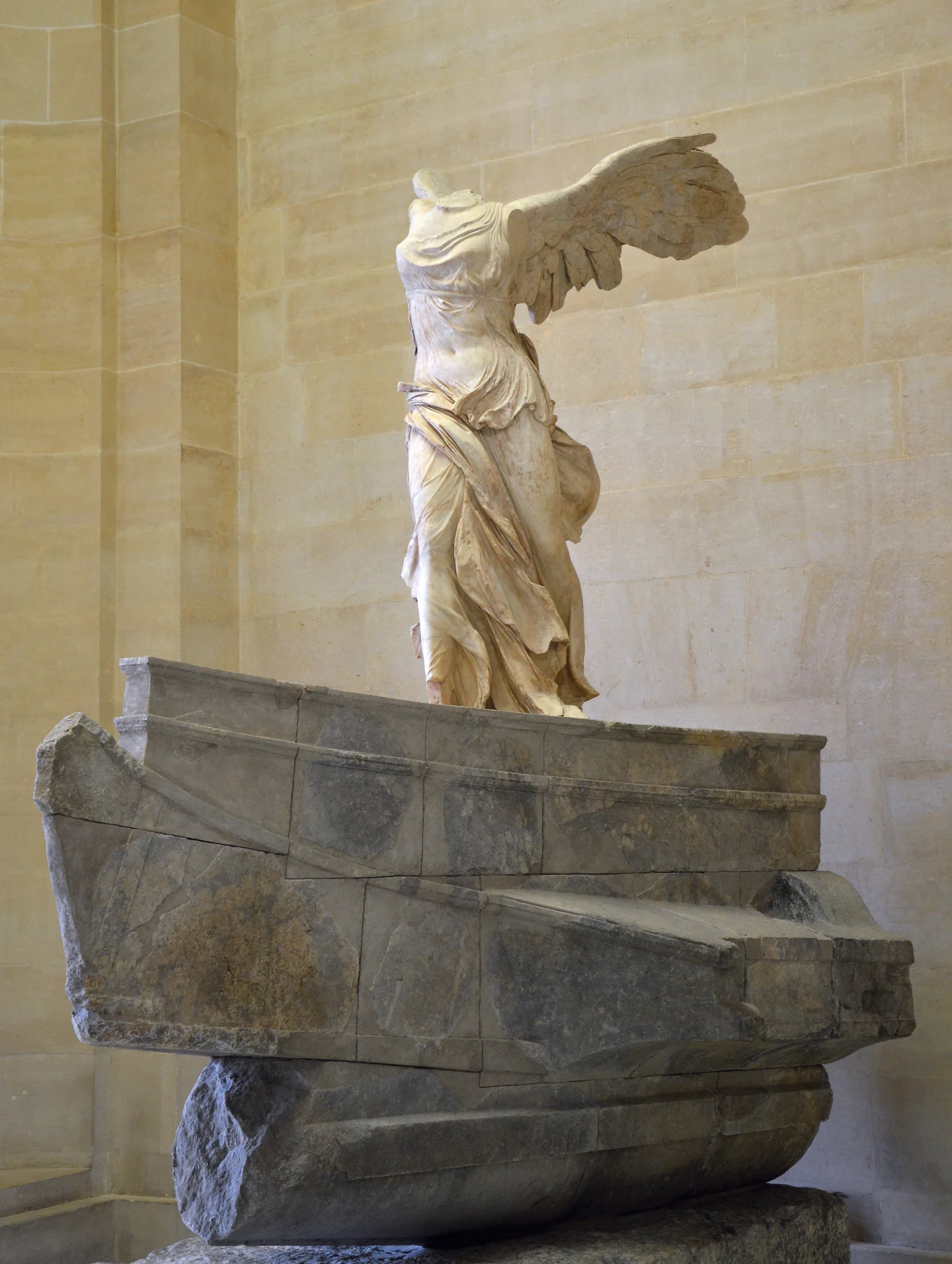
She has no head. She has no arms. She has never needed them.
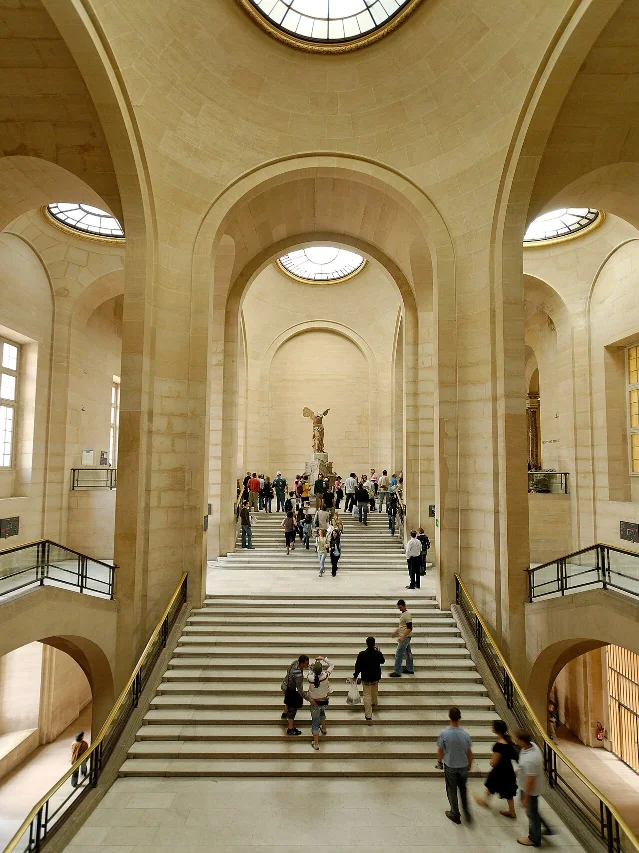
Around 190 BCE, the people of Rhodes commissioned a marble Nike to commemorate a naval triumph and placed her on a warship's prow at the Sanctuary of the Great Gods on Samothrace. French diplomat Charles Champoiseau found her in pieces in 1863 — and misidentified the ship's base as rubble. It took Austrian archaeologists sixteen years to correct the mistake. Today, headless and armless, she stands at the top of the Louvre's Daru staircase, still leaning into a wind nobody can see.
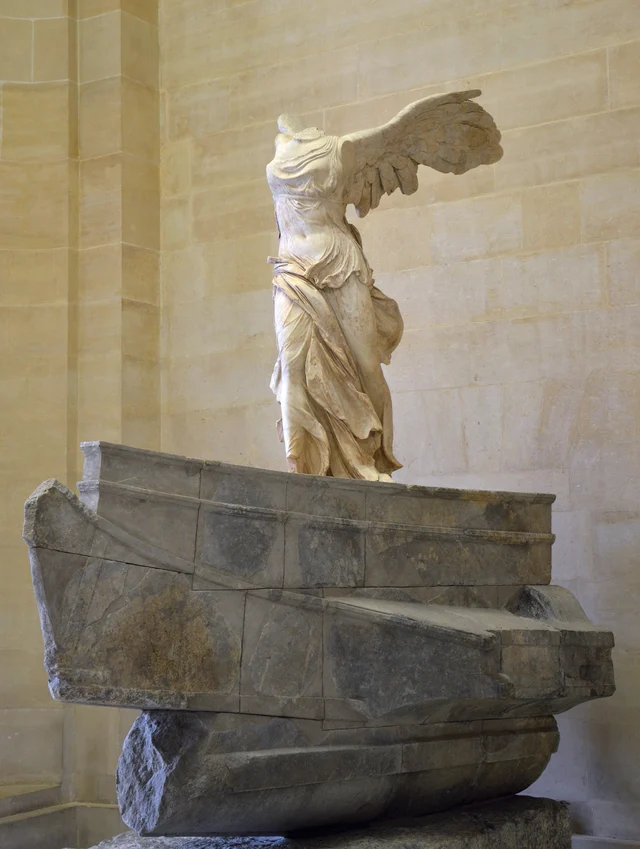
At the top of the Daru staircase in the Louvre's Denon Wing, a headless goddess stands on the prow of a warship and leans into a wind that stopped blowing roughly 2,200 years ago. 1 The wet linen of her chiton plasters itself against her abdomen and thighs; her himation, the heavier outer cloak, billows and strains at the hip as though it might tear free at any moment. Her wings — one marble, one plaster — are thrown back. She is 2.75 meters tall and weighs around 2,000 kilograms. 2 The ship beneath her, assembled from sixteen blocks of grey Lartos marble quarried on the island of Rhodes, adds another 2.01 meters of height and perhaps 30,000 kilograms of weight. She is, in the language of accession registers, Louvre Ma 2369. 2
She is also, by the reckoning of most people who have walked up those stairs, one of the most physically overwhelming objects in any museum on earth.
An island sanctuary and a forgotten fleet
The goddess is Nike (Νίκη), the ancient Greek personification of victory, and she was made sometime around 190 BCE — the first quarter of the second century before the common era, deep in the Hellenistic period that followed the death of Alexander the Great. 3 Her dedicants were almost certainly the people of Rhodes, whose navy was one of the most capable in the eastern Mediterranean. 1
The scholars' leading candidate for the victory being commemorated is the Battle of Myonessus in 190 BCE, when a Rhodian-Roman fleet crushed the Seleucid navy of Antiochus III in the waters off the Anatolian coast — a fight that helped seal Rome's first major foothold in the Greek-speaking east. 1 The historian Nathan Badoud, writing in 2018, has argued instead for the Battle of Chios of 201 BCE, when Rhodes and Pergamon together checked the ambitions of the Macedonian king Philip V. 1 Neither case is closed: the dedicatory inscription was never found, and the sculptor's identity is known only from a small fragmentary text reading "[…]Σ ΡΟΔΙΟΣ" — "of Rhodes" — which the German art historian Hermann Thiersch reconstructed in 1931 as the name Pythokritos, son of Timocharis, a Rhodian sculptor active between roughly 210 and 165 BCE. 1
The monument was erected not in Rhodes but on the small island of Samothrace, in the northern Aegean. The site was the Sanctuary of the Great Gods (Ιερό των Μεγάλων Θεών), one of the most important pan-Hellenic religious centers of the Hellenistic world — a sanctuary devoted to the Cabeiri (Κάβειροι), a group of divinities whose true names were ritual secrets, and whose particular specialty was protecting sailors from shipwreck and granting victory in naval combat. 4 Famous initiates of the Cabeiri mysteries included Herodotus and the Spartan general Lysander; the sanctuary is mentioned in both Plato and Aristophanes. 4 During the Hellenistic period, after Philip II of Macedon's patronage, it had become a kind of dynastic showcase where the successors of Alexander competed in displays of piety and munificence.
The Nike monument stood at the south end of a raised terrace, positioned obliquely so that its left side faced down the valley of the sanctuary's river — the only unobstructed sight line through the whole complex. 1 A worshiper approaching along that axis would have seen the ship's prow emerging above the roofline first, then the figure of the goddess, leaning forward as if she had just swept in from the sea to announce a triumph. The effect was theatrical. The Rhodians had used it deliberately.
A sculptor's argument about invisible things
Sculptures of Nike were nothing new in 190 BCE. The Nike of Paionios, carved around 420 BCE and still standing today in the Archaeological Museum at Olympia, shows the goddess descending vertically from the sky, robes pressed close to her body in the same wet-drapery style. 5 But the Samothrace sculptor made something different in kind, not just in degree.
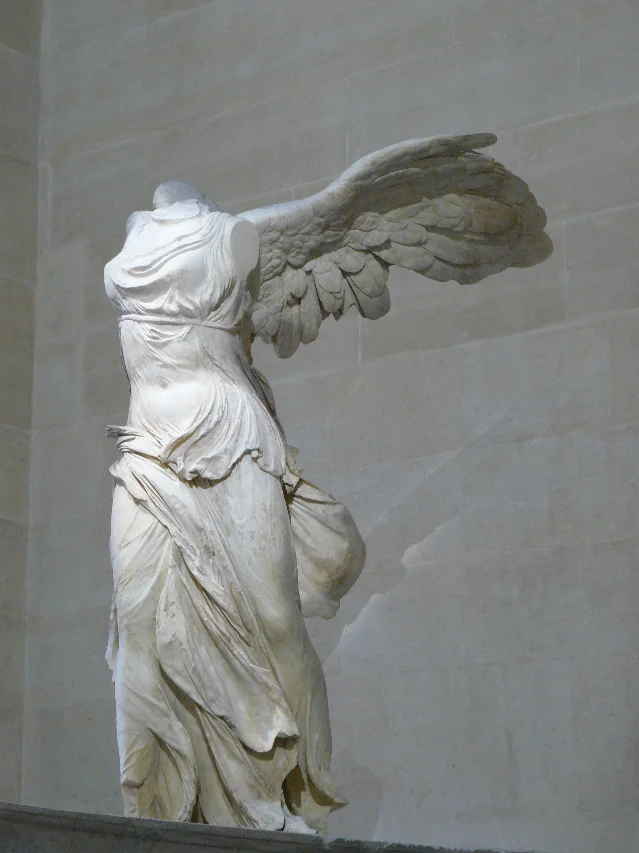
The figure wears two garments: a thin chiton (χιτών) that bunches in a band above the waist and then clings to the belly, left leg, and right thigh as though soaked; and a heavier himation (ἱμάτιον) wound around the hips, one end sliding toward the ground, the other trailing behind the right leg held there by nothing but wind and forward momentum. 1 The sculptor carved these two garments at very different levels of finish: the left front of the statue, the angle from which the monument was designed to be seen first, is cut with almost obsessive intricacy — the chiton alternating between tight adhesion and deep shadow-casting folds, the himation bunching in thick ropes where it resists the air. The right side, by contrast, is carved in broad, simple planes. This is not neglect. It is a choice about where the viewer's eye should land.
The art historian H. W. Janson observed that unlike earlier Greek or Near Eastern sculpture, the Nike establishes a deliberate relationship with imaginary space — the wind and the sea are not depicted anywhere on the monument, yet the sculpture makes the viewer supply them. 1 That technique — pulling the beholder's imagination into the work — would not become common in Western art until the Baroque, roughly two thousand years later. Margarete Bieber, in her 1955 study of Hellenistic sculpture, placed the Nike as a foundational work of what she called the "Rhodian school" and "Hellenistic Baroque," alongside the Gigantomachy frieze of the Pergamon Altar and the Laocoön group. 1 It is one of a tiny number of major Hellenistic statues to survive in the original marble rather than as a Roman copy. 2
The French consul who found a goddess in the rubble
On the morning of April 13, 1863, a French diplomat named Charles Champoiseau (1830–1909) was excavating the ruins of the Samothrace sanctuary under permit from the Ottoman Empire, which then governed the island. Champoiseau held the title of acting chief of the French Consulate in Adrianopolis (today Edirne, Turkey) and had a sideline passion for antiquities. 1 That morning he uncovered a large fragment of white Parian marble torso, surrounded by drapery and feather fragments — roughly 110 pieces in all. He recognized the figure immediately as Nike and decided to ship the whole assembly to the Louvre. 6
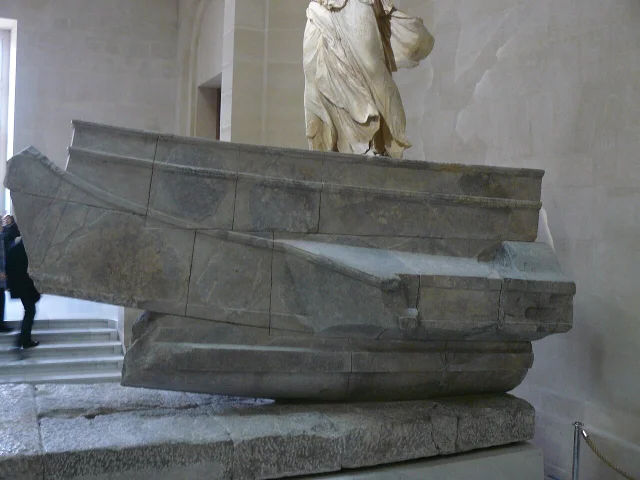
In the same rubble he found about fifteen large blocks of grey marble. He could make nothing of them and left them behind, concluding they must be part of a funerary monument. He departed Samothrace in early May 1863; the statue reached Toulon at the end of August and arrived in Paris on May 11, 1864. 1
The first curator to work with the statue, Adrien Prévost de Longpérier, assembled the body and its drapery fragments and put the result on display first in the Salle des Caryatides, then briefly in the Tiber Room. He could see that the figure was exceptional. What he had no way of knowing was that he had not yet found the most important part.
Between 1870 and 1875, a team of Austrian archaeologists led by Alexander Conze excavated the sanctuary and turned their attention to those grey marble blocks Champoiseau had left behind. The team's architect, Aloïs Hauser, drew each block and realized that when properly assembled they formed the tapered bow of a warship — a trihemiolia, the characteristic light-galley of the Rhodian navy. 1 Numismatic evidence supported the reconstruction: silver tetradrachms of Demetrios Poliorcetes, struck around 300 BCE, depicted a winged Nike standing on exactly such a ship's bow. The sculptor Otto Benndorf, also part of the Austrian team, studied the body at the Louvre and proposed the goddess had been blowing a trumpet — a reconstruction that was later disproven when her actual hand gesture came to light, but which, combined with Hauser's prow drawings, helped establish the ship-monument concept.
Informed of the Austrian findings, Champoiseau returned to Samothrace in August 1879 — solely to retrieve the grey marble blocks. Two months later they reached the Louvre, and in December 1879 an assembly test was conducted in a courtyard. 1 The ship's prow was real. The monument had a base.
Champoiseau made a third and final trip to Samothrace in 1891, specifically to search for the head. He failed to find it. He brought back instead some drapery fragments, base debris, a small inscribed fragment (the one Thiersch would later study), and several pieces of painted plaster. 1 The head of the Winged Victory has never been found.
The Daru staircase and the music-hall star problem
Félix Ravaisson-Mollien, curator of the Department of Antiquities, oversaw the full reconstruction between 1880 and 1883. He placed the right marble bust fragment, rebuilt the left bust in plaster, attached the original left wing to the body with a metal frame, replaced the entire right wing with a plaster cast, and reassembled the ship's prow. He chose not to reconstruct the head, the arms, or the feet — a decision remarkable for its era, when Victorian restoration practice routinely supplied whatever was missing. 1 In 1883, the completed monument was installed at the top of the Daru staircase, the main ceremonial approach to the Louvre's Denon Wing. 6
The staircase itself had been designed by the architect Hector Lefuel during Napoleon III's 1850s expansion of the Louvre — one of six grand staircases built in that period, organized on three levels with natural light filtering down from a glass ceiling. 6 The spatial logic of the installation was intentional: a visitor ascending toward the paintings galleries above would encounter Nike exactly as worshipers at Samothrace had encountered her — suddenly, from below, at the end of a long approach. The Louvre later noted that this placement replicated something of the statue's original "lofty position overlooking the Samothrace sanctuary." 6
There was, however, a décor problem. The 1880s Louvre had dressed the Daru landing in heavily gilded mosaics, a scheme that critics compared to the backdrop of a music-hall stage — the French phrase was danseuse de music-hall, a music-hall dancer. The observation was damaging enough to prompt a complete overhaul in 1934, when the mosaic ceiling was covered in wallpaper imitating cut stone, the staircase steps were widened, and the monument was advanced on the landing to make it more visible from below, now elevated on a modern 45-centimeter stone block intended to evoke a warship's combat bridge. 1 6 That 1934 configuration is essentially what visitors saw until 2013.
Five years into the 1934 arrangement, war intervened. In September 1939, as France mobilized, the Louvre began a systematic evacuation of its most significant holdings. The Winged Victory was disassembled, crated, and moved to the Château de Valençay in the Indre department of central France, where it sat out the Occupation alongside the Vénus de Milo and thousands of other objects. 1 In July 1945, following the Liberation, she returned to the top of the Daru staircase undamaged.
The hand in Vienna, the blue paint on the wings
In July 1950, a Louvre curator named Jean Charbonneaux was excavating at Samothrace when he found the right palm of the statue — its fingers spread open, the gesture not of someone holding a trumpet or a wreath (as earlier reconstructions had assumed) but of greeting, of salutation. 1 Two fingers that matched the hand had been sitting in the collections of the Kunsthistorisches Museum in Vienna since 1875, extracted during the Austrian excavations. 1 In 1954, the palm and fingers were brought together in a display case beside the statue — never reattached to the body, but finally reunited in the same room.
Also in 1952, Charbonneaux retrieved that largest unsculpted base block that Champoiseau had left on the island in 1879. It had been sitting at Samothrace for seventy-three years.
The most recent and thorough examination of the whole monument came in 2013–2014, when the Louvre undertook the "Nike Project" — a complete scientific and physical restoration. 1 2 The statue was removed from its base for the first time since 1934. Every surface was examined under UV light, infrared, X-ray, and microspectrography. The base blocks were individually disassembled, drawn, and restudied.
The most striking discovery was about color. Traces of blue paint were detected on the wings and along a band at the lower hem of the himation. 1 The Winged Victory, which the modern world imagines as purely white, was originally polychrome. How extensively she was painted, and in what palette, the analysis did not fully resolve — but the evidence for color is now physical fact, not speculation. Jean-Luc Martinez, then director of the Louvre, documented the project in a 2014 paper for the Comptes rendus de l'Académie des Inscriptions et Belles-Lettres, describing it as "un projet international de recherche et de restauration du monument." 1
Previously stored fragments were incorporated: a feather at the top of the left wing (positioned in the spread attitude of a bird completing a landing), a fold of fabric at the back of the chiton. The metal brace behind the left leg — an ungainly piece of 19th-century structural engineering — was removed. A cast of the seventeenth base block, still at Samothrace, was integrated. When the monument was reassembled, the color contrast between the white Parian marble statue and the grey Lartos marble ship emerged more sharply than it had in generations. 1
The statue was returned to the landing in July 2014, set slightly farther back from its 1934 position to improve visitor circulation. She remains there now.
From the Rhodian navy to the Nike swoosh
In 2013, while the Louvre restoration was underway, the Greek Deputy Minister of Foreign Affairs Akis Gerondopoulos offered a pointed observation: "If the French and the Louvre have a problem, we are ready to preserve and accentuate the Victory of Samothrace, if they return it to us." 1 The French position has remained consistent: Champoiseau excavated the statue legally under Ottoman permission and donated it to the Louvre. The statue is not subject to the same active repatriation dispute as the Parthenon Marbles, but the question has not disappeared entirely.
It rarely does with objects of this magnitude. The Winged Victory is, alongside the Mona Lisa and the Vénus de Milo, one of the three works most visitors to the Louvre specifically come to see. 2 Its cultural footprint extends well beyond the museum's walls.
In 1911, the British sculptor Charles Sykes designed the hood ornament for Rolls-Royce: a forward-leaning woman with arms swept back, drapery rippling as though in wind. The Spirit of Ecstasy shares the fundamental compositional logic of Nike — a winged female figure pressing into forward motion, fabric animated by speed. Whether Sykes consciously referenced the Louvre statue is not documented. 7
In 1971, a Portland State University graphic design student named Carolyn Davidson was paid $35 by an accounting instructor named Phil Knight to design a logo for a new sportswear company. She produced a curved stroke meant to suggest the wing of a goddess. Knight's employee Jeff Johnson had already suggested the company's name: Nike. 8 9 The Swoosh was first used on June 18, 1971, and registered at the U.S. Patent and Trademark Office on January 22, 1974. 8 By 2025, the Nike brand was valued at $90 billion. 9 Davidson — who later received a gift of Nike stock from Knight — designed the symbol the same year the Louvre's second-most-visited statue was undergoing one of its periodic restorations; neither party appears to have noticed the coincidence.
The more intentional artistic responses have been numerous. Frank Lloyd Wright placed casts of the Nike in multiple private houses, including the Ward Willits House and the Darwin D. Martin House. 1 The artist Yves Klein — inventor of International Klein Blue — began producing versions of the statue coated in his signature ultramarine pigment and suspended in resin in 1962, under the title La Victoire de Samathrace. 1 The first FIFA World Cup trophy, designed by Abel Lafleur for the 1930 tournament, was modeled on the Nike's form. 1 The Swedish poet Gunnar Ekelöf, in his 1941 poem Samothrace, used the headless figure as a symbol of resistance against fascism — a victory whose meaning could not be captured, interrogated, or silenced because it had no face to name. 1
This last reading may be the most instructive. The statue works partly because of its incompleteness. Visitors who see the Mona Lisa see a face — a specific woman looking at them with a specific expression, generating centuries of argument about exactly what that expression means. Visitors who see the Winged Victory see a body in motion, force made visible, a moment of arrival so complete that the absence of a head becomes almost beside the point. What could a face add? The goddess already has everything she needs to announce what she came to announce.
She arrived at the Louvre's loading dock on a May morning in 1864, in pieces, after a journey from a Greek island via a Toulon harbor. She has been stopping people on a staircase ever since.
Cover image: Winged Victory of Samothrace (Nike of Samothrace), Louvre Ma 2369, c. 190 BCE. Parian marble (statue) and Lartos marble (ship's prow base). Height with wings: 2.75 m; total monument height: c. 5.57 m. Image: Wikimedia Commons, CC BY-SA 4.0.
参考来源
- 1Winged Victory of Samothrace — Wikipedia
- 2Victoire de Samothrace — Louvre collections
- 3Hellenistic period — Wikipedia
- 4Samothrace temple complex — Wikipedia
- 5Nike (mythology) — Wikipedia
- 6A stairway to Victory — The Daru staircase — Louvre
- 7Spirit of Ecstasy — Wikipedia
- 8Swoosh — Wikipedia
- 9Nike, Inc. — Wikipedia
围绕这条内容继续补充观点或上下文。