Twelve Seconds Over Kill Devil Hills: The 1903 Wright Flyer's Long Road to the Smithsonian
In 1903, Orville and Wilbur Wright flew a spruce-and-muslin biplane four times at Kill Devil Hills — 98 seconds total, never to fly again. The machine then survived an Ohio flood, spent 20 years in London exile after Orville refused to donate it to a Smithsonian that had credited a rival's aircraft with the achievement, weathered a world war in a Wiltshire quarry, and returned home on an ocean liner in 1948 — sold to the nation for one dollar. It now hangs in Washington's National Air and Space Museum, accession A19610048000.

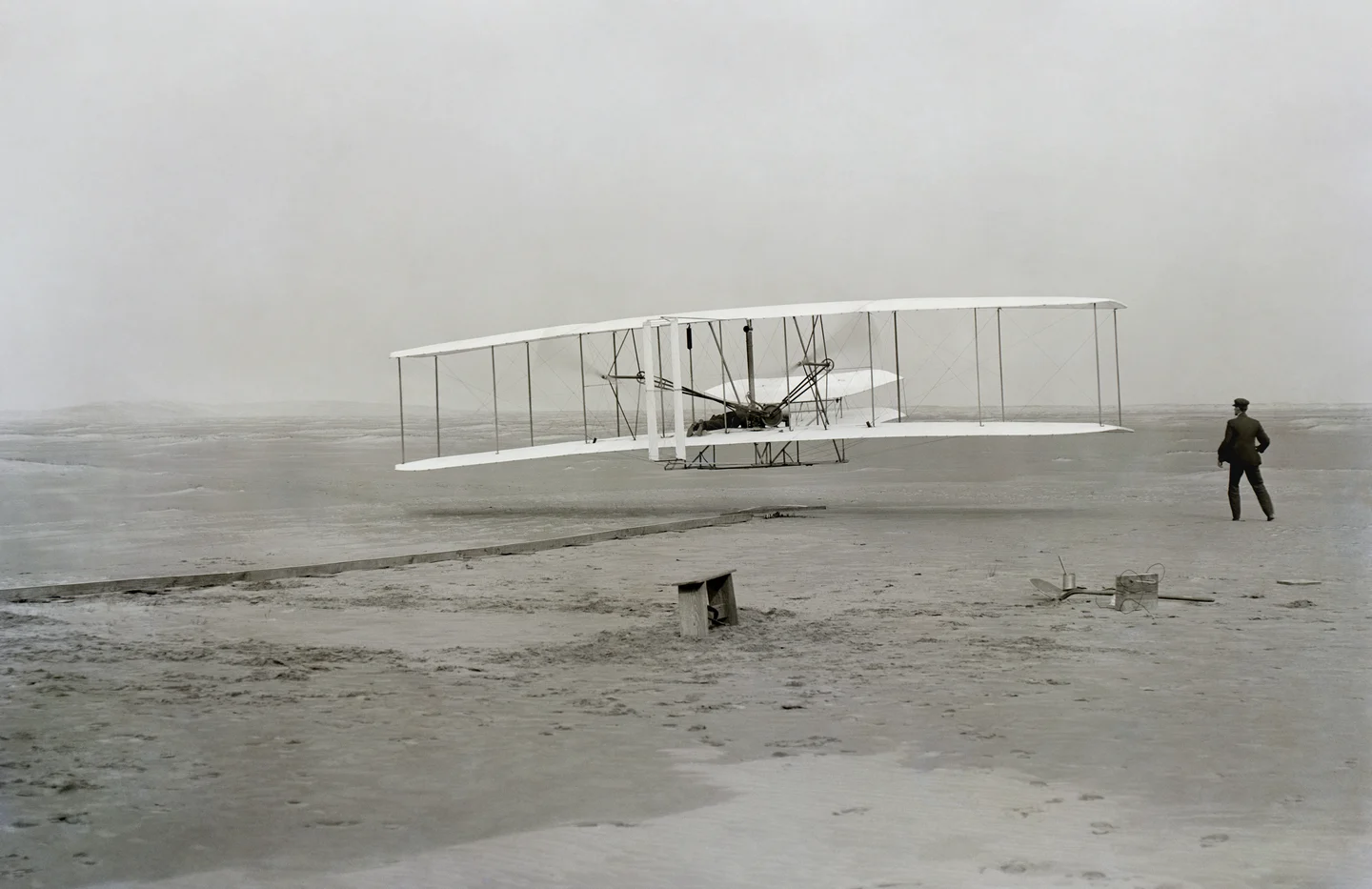
At 10:35 in the morning on December 17, 1903, a U.S. Life-Saving Service crewman named John T. Daniels stood beside a wooden launching rail on the sand flats of Kill Devil Hills, North Carolina, and squeezed the rubber bulb of a camera he had never operated before. He was following instructions: Orville Wright had set up his own camera on a tripod, aimed at the precise point where the machine would leave the rail, and told Daniels to squeeze when it lifted. 1
The machine lifted. The photograph caught it two, maybe three feet off the ground: Orville prone on the lower wing, Wilbur running alongside the right wingtip, having just let go. The front elevator is angled slightly upward. The sixty-foot launching rail is visible below. The whole contraption looks improbably fragile — muslin and spruce and a chain-drive engine, held together with wire and ambition.
That flight lasted twelve seconds and covered 120 feet. 1 Three more flights followed that morning. By noon the Flyer had been wrecked by a gust of wind and would never fly again. By most measurements — distance, duration, mechanical complexity — the achievement was modest. By every other measure it was the most consequential twelve seconds in the history of transportation.
The machine that made those flights is now suspended from the ceiling of the National Air and Space Museum in Washington, D.C., accession number A19610048000. 1 Getting it there took 45 years, a flood, a transatlantic feud, a world war, a diplomatic crisis, and a contract that sold the most important aircraft in history for one dollar.
What the machine actually is
The Flyer is a canard biplane — the elevator is mounted in front of the wings, not behind, which is why it looks backwards to modern eyes. 2 Its wingspan runs 12.3 meters (40 feet 4 inches); its length, 6.4 meters (21 feet 1 inch); its height, 2.8 meters (9 feet 4 inches). 1 Empty, it weighed 274 kilograms (605 pounds). The fabric covering — 100% cotton "Pride of the West" muslin, the same material used for women's underwear, woven at 107 threads per inch in the warp and 102 in the weft — was chosen not for aerodynamic sophistication but because it was the most consistently tight-weave cotton available and had no surface finish to add weight. 2
The right wing is four inches longer than the left. This was deliberate: the engine, mounted just to the right of center, weighed 30 to 40 pounds more than the pilot, and the asymmetry partly compensated for the imbalance. 2 The spruce spars — the long horizontal structural members — had "Wilbur Wright" and the destination "Elizabeth City, N.C." written on them in pencil, still legible when the machine was disassembled for the 1985 restoration. 3 Inside one wingtip, a stamp read "Browns" — identified as S.N. Brown Co., a Dayton carriage company; the wingtip bows were made from the same bent-wood stock used for folding carriage roofs. 3
The engine was built in six weeks by Charlie Taylor, the Wright brothers' bicycle-shop mechanic, who had never built an engine before. 2 It was a four-cylinder inline water-cooled unit, 201.1 cubic inches in displacement, producing 12 horsepower at 1,025 revolutions per minute. Taylor later recalled: "They figured on four cylinders and estimated the bore and stroke at four inches... The completed engine weighed 180 pounds and developed 12 horsepower at 1025 revolutions per minute... The body of the first engine was of cast aluminum." 2 That aluminum crankcase was the first time aluminum had been used in any aircraft engine — the aviation industry's first deployment of a metal that would later build most of the planes that followed. 4
The propellers — twin pusher props, driven by bicycle chains running from the engine — were designed by applying wind-tunnel airfoil principles. The Wrights had grasped something their rivals had not: a propeller is a rotating wing. Using data from their own 200-airfoil wind-tunnel experiments in 1901, they designed 8.5-foot spruce blades that achieved roughly 82% efficiency, a figure that would not be significantly improved for decades. 5 The two props counter-rotated — one chain was crossed — to cancel the torque that would otherwise yaw the aircraft off course. 2
The control system was the invention that actually mattered. Previous would-be aviators had tried to build aircraft that were inherently stable — machines that would fly straight and level without pilot input, the way a well-trimmed sailing vessel holds its course. The Wrights, who had spent years riding and selling bicycles, took the opposite approach: a bicycle is inherently unstable, and the rider learns to manage that instability. Their Flyer was designed to be responsive to control inputs rather than resistant to them. The mechanism was wing-warping: the pilot, lying prone on the lower wing, moved a hip cradle that pulled wires to twist the wingtips in opposite directions, creating differential lift on the two sides — roll control. This was linked to a movable rear rudder for coordinated turns. The forward elevator controlled pitch. Three axes of control, working together: the world's first three-axis flight control system. 4
Peter Jakab, a Smithsonian curator who spent years studying the brothers' design process, has argued that "perfection of the 1902 glider essentially represents the invention of the airplane" — that adding power was almost an afterthought once three-axis control was solved. 5 The Flyer is, from this angle, less a machine than a proof: proof that the problem of controlled flight could be separated from the problem of engine power, and that solving control first was the right sequence.
The four flights and the gust that ended them
December 17, 1903 was cold and windy at Kill Devil Hills, four miles south of Kitty Hawk — headwinds gusting to 27 miles per hour, temperature near freezing. 2 Three days earlier, on December 14, Wilbur had won the coin toss for the first attempt and managed only 3.5 seconds and 105 feet before the Flyer climbed too steeply, stalled, and hit the ground — minor damage, repaired overnight. 4
Now it was Orville's turn. Five witnesses had come from the U.S. Life-Saving Service station: Adam Etheridge, John T. Daniels (the photographer), and Will Dough, plus W.C. Brinkley, a local businessman, and Johnny Moore, a teenager from the area. 2 At 10:35 a.m., the Flyer slid down the sixty-foot launching rail — a wooden track they called the "Junction Railroad" — and into the air.
Twelve seconds. One hundred and twenty feet. Ground speed approximately 6.8 miles per hour; airspeed through the headwind closer to 30 miles per hour; altitude roughly ten feet. 1 The flight was wildly unsteady — the forward elevator overresponsive, the machine undulating up and down — but it was controlled, and it was powered, and it was heavier than air.
Three more flights followed. Wilbur flew the second, Orville the third. Then, at around noon, Wilbur took the controls for the fourth time. Orville noted in his diary: "Wilbur started the fourth and last flight at just about 12 o'clock. The first few hundred feet were up and down, as before, but by the time three hundred ft had been covered, the machine was under much better control. The distance over the ground was measured to be 852 feet; the time of the flight was 59 seconds." 4
Fifty-nine seconds. Eight hundred and fifty-two feet. Just over a quarter mile through the air. Hard landing, which broke the front elevator supports — but the main structure was intact.
Minutes later, a gust of wind caught the Flyer as it sat on the ground. It tumbled end over end across the sand, breaking every wing rib. All four flights had taken place on the same machine, on the same day, in roughly ninety minutes. The machine never flew again.
That afternoon, Orville sent a telegram to their father, the bishop Milton Wright, in Dayton: "Success four flights thursday morning all against twenty one mile wind started from Level with engine power alone average speed through air thirty one miles longest 57 seconds inform Press home Christmas." 4 (The telegram slightly understated the fourth flight's duration; Orville's diary figure of 59 seconds is the more careful measurement.) No newspaper carried the story that day. The Associated Press bureau in Norfolk dismissed it as unverified. Bicycle mechanics from Ohio had invented the airplane, and the world needed a few days to notice.
Thirteen years in a shed, then a flood
The Wrights packed the wrecked Flyer into shipping crates at Kitty Hawk and sent it back to Dayton. 3 For the next thirteen years it sat untouched in a shed behind the bicycle shop at 1127 West Third Street — not because the brothers were sentimental about it, but because they had moved on. The Wright Flyer II flew in 1904; the Flyer III in 1905. The 1903 machine was already obsolete. In 1906, the engine's crankshaft and flywheel were loaned to an aeronautical exhibit in New York and never returned — they disappeared entirely. 3
By 1912, Wilbur was dead of typhoid fever at 45. Around the same time, Roy Knabenshue — who managed the Wrights' exhibition team — persuaded Orville not to burn the Flyer, as he had burned the 1904 machine. Orville agreed to keep it. 6
Then came the flood.
In March 1913, the Great Dayton Flood — one of the worst natural disasters in Ohio's history — sent the Miami River surging through the city. The Flyer's crates were submerged under nearly twelve feet of muddy water for eleven days. 6 When the waters receded, the crates were moved to a barn, and eventually to a brick building Orville used as a laboratory.
In the summer of 1916, Orville finally opened them for the first time since Kitty Hawk. He was preparing the Flyer for exhibition at the dedication of new buildings at MIT in Cambridge — its first public appearance since the day it was built. 3 The damage from the flood, combined with the tumble that had ended its last flight, had been substantial: the rudder and forward elevators were almost entirely rebuilt; the main spars of the wing center-sections were replaced; the wing center-section fabric was replaced with new Pride of the West muslin (the outer wing panels still held the original 1903 covering). The engine was rebuilt using parts from a similar 1904 machine. Mechanic Jim Jacobs did the assembly work under Orville's supervision. 6
The Flyer exhibited at MIT in 1916, then at the Pan-American Aeronautical Exposition in New York in 1917, and at a few other venues through 1924. Each time, Jacobs reassembled it. Orville watched over it carefully. He was already thinking about where it would permanently live — and that question was about to produce a diplomatic rupture.
The Smithsonian's gamble with history
Samuel Pierpont Langley, Secretary of the Smithsonian Institution from 1887 until his death in 1906, had spent more than $70,000 in public and institutional funds trying to build a piloted aircraft. 7 His "Great Aerodrome" failed twice in 1903: on October 7, it collapsed on launch from a houseboat on the Potomac River; on December 8 — nine days before the Wrights' success at Kitty Hawk — it crashed again. Both times, pilot Charles Manly survived by wearing a cork life vest. 7 The Great Aerodrome had never flown.
But Langley was a Smithsonian hero, and his successor Charles D. Walcott was Langley's close friend. In 1914, Walcott authorized aviation pioneer — and Wrights' bitter patent rival — Glenn Curtiss to rebuild and fly the Aerodrome. The Smithsonian paid Curtiss $2,000. 7 Curtiss made extensive modifications to the machine — later enumerated by the Smithsonian itself as 35 separate changes, including replacing hollow-core wing ribs with solid laminated wood, doubling the wing spars, changing the wing camber, adding pontoons, installing standard Curtiss controls, and replacing Langley's porous original fabric covering with airtight doped cotton. 8
On May 28, 1914, Curtiss flew the modified machine at Lake Keuka in Hammondsport, New York — briefly, at low altitude, in calm conditions with a favorable breeze over water. The Smithsonian then returned the Aerodrome to something resembling its 1903 configuration and put it on display with a label that read: "Original Langley flying machine, 1903, the first man-carrying airplane in the history of the world capable of sustained free flight." 8
Orville Wright, who had watched the patent wars, the Curtiss modifications, and the Smithsonian's annual reports credit Langley year after year, found this intolerable. In a letter he described the institution's campaign as "a subtle campaign to take from us much of the credit then universally accorded us... accomplished through some clever and some absolutely false statements." 9 He tried negotiation, arbitration, and an appeal to Chief Justice William Howard Taft (then Chancellor of the Smithsonian) for an impartial investigation. Taft declined. 8
On April 30, 1925, Orville made his decision public: he would send the Flyer to the Science Museum in Kensington, London. "I believe my course in sending our Kitty Hawk machine to a foreign museum," he wrote, "is the only way of correcting the history of the flying machine, which by false and misleading statements has been perverted by the Smithsonian Institution." 9
Twenty years in London
Before shipping the Flyer to England, Orville refurbished it completely. In late 1926 and early 1927, he and mechanic Jim Jacobs replaced all of the original fabric with new Pride of the West muslin — meaning the 1903 covering was removed. Orville saved the material he took off; portions of it survive today, including a large section of one wing panel later donated to NASM by his niece Ivonette Wright Miller in 1981. 6
On January 28, 1928, the Flyer was shipped to England. 3 "I have sent our original 1903 machine to the British National Museum because of the hostile and unfair attitude shown towards us by the officials of the Smithsonian Institution," Orville wrote in the March 1928 issue of U.S. Air Services magazine. 9 He added, in words that sound both principled and weary: "I regret more than anyone else that this course was necessary." 9
The Science Museum gave the Flyer "the place of honour" in its collection. King George V and Queen Mary inspected it in 1928. 6 It remained in Kensington for twelve years.
When the Blitz began in September 1940, the Science Museum evacuated its most significant holdings. The Flyer was moved to underground storage in a former stone quarry complex near the village of Corsham in Wiltshire, roughly 100 miles from London — not the London Underground, as some accounts have claimed, but a converted network of Bath stone workings used by the British government for wartime storage. 2 It spent the war there alongside other British national treasures, undamaged.
Fred Kelly, Charles Abbot, and the apology that unlocked the door
The man who finally broke the deadlock was not a diplomat or a scientist but a journalist. Fred C. Kelly, who was writing the first authorized biography of the Wright brothers, contacted Smithsonian Secretary Charles Abbot in early 1942, noting that his book would contain an entire chapter on the feud. 10 Over the next several months, Kelly navigated between a reluctant Abbot and an embittered Orville — a biographer playing the role of mediator.
Abbot faced competing pressures: the Board of Regents wanted the embarrassment of the exile to end; Frederick C. Walcott (nephew of the previous secretary) was on the board and protective of his uncle's reputation; Albert Zahm, who had been Curtiss's technical expert in the patent lawsuits and now worked at the Library of Congress, was anxious about his own part in the affair. 10
By late September 1942, Abbot had a draft he could live with. On October 23, the two men met at a meeting of the National Advisory Committee for Aeronautics (NACA), and Orville was, by one account, "as happy as a schoolboy over the outcome." 10 On October 26, 1942, the Smithsonian published "The 1914 Tests of the Langley 'Aerodrome'" — listing every change Curtiss had made to the machine and stating plainly that the 1914 flights "did not warrant statements published by the Smithsonian Institution that these tests proved that the Langley machine of 1903 was capable of sustained flight carrying a man." 10
The New York Times ran an editorial calling it "a sweeping repudiation of past Smithsonian claims" and added: "Perhaps Orville Wright will now bring the Kitty Hawk plane home to the United States, where it should rest forever." 10
Orville agreed to bring it home. On December 17, 1943 — the 40th anniversary of the first flight — President Roosevelt was to announce the return at a White House dinner, but he was too ill, having recently returned from the Tehran Conference. Secretary of Commerce Jesse Jones read Roosevelt's words instead: "The nation will welcome it back as the outstanding example of American genius." 10
Operation Homecoming, the one-dollar contract, and the ceremony without its maker
The Flyer spent a few more years in the Corsham quarry, waiting for the war to end and for Smithsonian staff to take precise measurements for a London replica. Orville agreed to leave it there until that work was done.
Then Orville suffered a heart attack in October 1947. On January 27, 1948, he had a second one. He died three days later, on January 30, at age 76 in Dayton, Ohio. 11 He never saw the Flyer return to America.
The executors of his estate, led by Harold Miller (husband of Orville's niece), fulfilled his wish. On October 18, 1948, the Flyer was formally handed over at the Science Museum to Livingston L. Satterthwaite, the American Civil Air Attaché, in a ceremony attended by British aviation pioneer Sir Alliott Verdon-Roe. 6 The operation was called "Operation Homecoming."
The Flyer crossed the Atlantic on the RMS Mauretania, arriving at Halifax, Nova Scotia on November 11, 1948, carrying 1,111 passengers. 6 Paul E. Garber, curator of the Smithsonian's National Air Museum, met the ship in Halifax and took command of the transfer. In Halifax he encountered John A.D. McCurdy — then Lieutenant Governor of Nova Scotia and a former member of Alexander Graham Bell's Aerial Experiment Association, a man who had worked alongside Glenn Curtiss in the early aviation years. McCurdy offered any assistance needed to get the Flyer home. 6
From Halifax, the crated Flyer went by U.S. Navy escort carrier USS Palau (CVE-122) to New York, and then by flatbed truck to Washington.
On November 23, 1948, the Smithsonian Contract was signed. The Estate of Orville Wright transferred the Flyer to the United States — represented by the Smithsonian — for the sum of one dollar. 12 The contract included a reversion clause, now formally part of American legal history, that reads in part: "Neither the Smithsonian Institution or its successors nor any museum or other agency, bureau or facilities administered for the United States of America by the Smithsonian Institution or its successors shall publish or permit to be displayed a statement or label in connection with or in respect of any aircraft model or design of earlier date than the Wright Aeroplane of 1903, claiming in effect that such aircraft was capable of carrying a man under its own power in controlled flight." 12 If breached, title reverts to the Wright heirs, with a five-year grace period to comply.
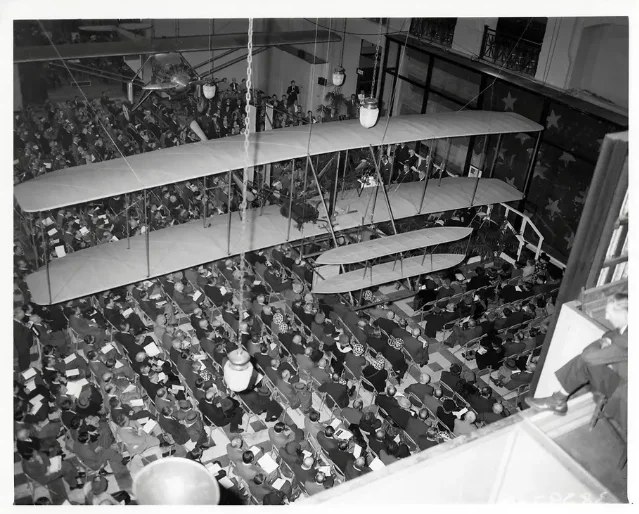
December 17, 1948 — exactly 45 years after the four flights at Kill Devil Hills — the Flyer was unveiled in the North Hall of the Smithsonian's Arts and Industries Building before more than 1,000 distinguished guests. Nearby hung Charles Lindbergh's Spirit of St. Louis, which had been in the hall for years; Lindbergh said he was honored to share space with the world's first airplane.
The British Ambassador, Sir Oliver Franks, offered the most economical tribute of the evening: "It is a little as if we had before us the original wheel." 6
Restorations, revelations, and a scrap of fabric on Mars
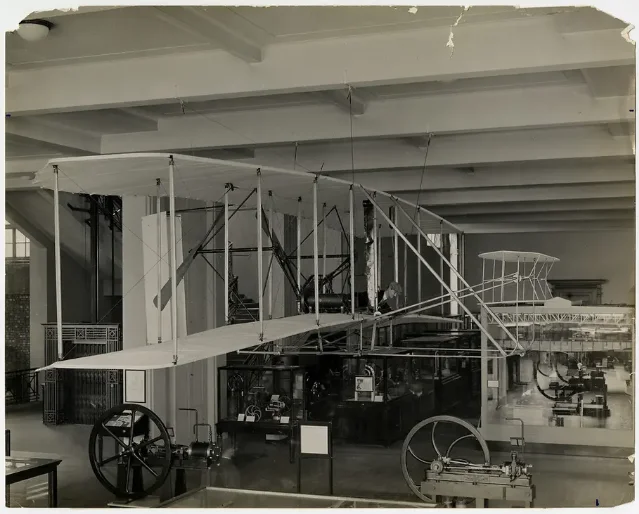
The Flyer hung in the Arts and Industries Building until 1976, when the new National Air and Space Museum building opened on the National Mall for the U.S. Bicentennial. It was moved to the "Milestones of Flight" gallery. 3
In 1981, Orville's niece Ivonette Wright Miller presented the museum with the large section of original 1903 wing fabric she had inherited from Orville — the material he had removed during the 1927 refurbishment. She expressed her wish to see the aircraft properly restored. 6
In 1984–85, the first major conservation treatment since Orville's own work was carried out in full public view, supervised by Senior Curator Robert Mikesh with historical guidance from Wright brothers expert Tom Crouch. Museum director Walter J. Boyne decided to perform the work where visitors could watch. 6 The wooden framework was cleaned; corrosion on metal fittings was treated; the engine received a coat of inert wax under new black paint (preserving the original paint beneath). The fabric was replaced using Orville's saved 1903 panel as the stitching pattern — restoring the exact 1903 sewing method, which the 1927 replacement had done slightly differently. 6 That treatment was designed to last approximately 75 years, to around 2060. 1
Tom Crouch, NASM Senior Curator, offered in 2013 a pointed assessment of what the contract governing the aircraft represents: "The contract remains in force today, a healthy reminder of a less than exemplary moment in Smithsonian history. Critics have also charged that no Smithsonian staff member would ever be willing to entertain such a possibility and risk losing a national treasure. I can only hope that, should persuasive evidence for a prior flight be presented, my colleagues and I would have the courage and the honesty to admit the new evidence and risk the loss of the Wright Flyer." 12
Meanwhile, portions of the original 1903 fabric that Orville saved have accumulated a travel record far beyond anything he imagined for the airplane itself. In July 1969, Neil Armstrong carried a piece of the Flyer's left propeller wood and a swatch of upper-left-wing muslin to the Moon in his Personal Preference Kit aboard the Lunar Module Eagle. 2 Those fragments are now displayed at the Wright Brothers National Memorial visitor center in Kill Devil Hills. In January 1986, separate pieces of wood and fabric, plus a note written by Orville Wright, flew aboard Space Shuttle Challenger on mission STS-51-L, carried by North Carolina astronaut Michael Smith. After Challenger was destroyed shortly after liftoff, the Flyer materials were recovered from the wreckage and are now at the North Carolina Museum of History. 2 And on April 19, 2021, a small rectangle of the Flyer's wing fabric was attached beneath the solar panel of NASA's Ingenuity helicopter, which made the first controlled atmospheric flight on Mars. The mission team named its base on Mars "Wright Brothers Field." 13
Where it hangs now
In 2003, for the centennial of flight, the Flyer was taken down from the "Milestones of Flight" gallery and moved into a dedicated space: "The Wright Brothers & The Invention of the Aerial Age." For the first time since Kitty Hawk, it was displayed at ground level — visitors could walk around it, come close enough to see the individual stitches in the muslin. 1
Following the museum's 2018–2022 renovation — supported in part by a gift from David M. Rubenstein — the gallery was reimagined, and the Flyer now hangs at approximately eye level, suspended so that visitors can examine it from multiple angles. 1 A life-size figure of Orville lies prone on the lower wing, replicating the pilot's position during the four flights. On the wall behind it: historical photographs, interpretive panels, cultural artifacts showing how the world absorbed the shock of human flight in the decade after 1903. The broken engine crankcase from the 1903 flights is displayed in the same gallery. 3
Accession number A19610048000 was assigned in 1961 — thirteen years after the Flyer arrived at the Smithsonian. Credit line: The Estate of Orville Wright. 1
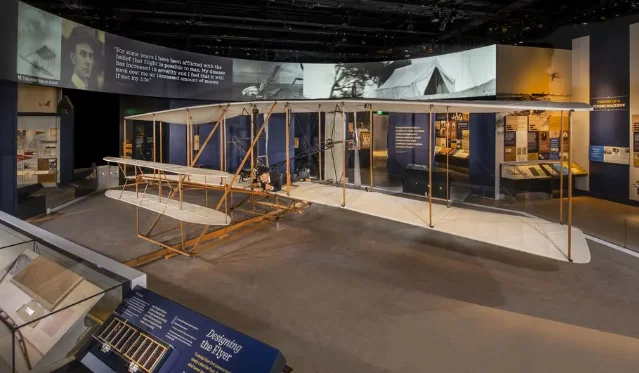
The Flyer is, in physical terms, a modest object: 274 kilograms of spruce, ash, muslin, and aluminum assembled by two bicycle mechanics who had no engineering degrees and no government funding, in a shed in Dayton, Ohio. Its total flying time was 98 seconds across four flights, all on the same cold morning in 1903, at altitudes that would barely clear a fence post. The engine crankshaft that was loaned to a New York exhibition in 1906 was never recovered. The fabric covering has been replaced twice. The machine was submerged in mud for eleven days, rebuilt after a flood, lent under protest to a foreign country for twenty years, shipped across the Atlantic on an ocean liner, transferred to a Navy carrier, trucked across Washington, and sold for a dollar.
None of that diminishes what it is. British Ambassador Franks got the scale exactly right: it is a little as if we had before us the original wheel. Most fundamental inventions lose their physical remains to time or obsolescence. The Flyer is here, under the same roof as the Apollo 11 command module and the Spirit of St. Louis, and visitors can walk up to it and count the stitches in the cotton.
Cover image: The first powered flight, December 17, 1903. Photograph by John T. Daniels, U.S. Life-Saving Service. Glass-plate original preserved in the Library of Congress. Public domain. Image via Wikimedia Commons.
参考来源
- 11903 Wright Flyer — NASM collection
- 2Wright Flyer — Wikipedia
- 3What happened to the original Wright Flyer? — NASM
- 4Wright brothers — Wikipedia
- 5Researching the Wright Way — NASM
- 6The Original — Smithsonian Magazine
- 7The Flight of the Langley Aerodrome — Wright Brothers Aeroplane Company
- 8Escalation — Wright Brothers Aeroplane Company
- 9Why the Wright Flyer was sent to England — Wright Brothers Aeroplane Company
- 10Resolution — Wright Brothers Aeroplane Company
- 1130 January 1948 — This Day in Aviation
- 12The Smithsonian Contract — Wright Brothers Aeroplane Company
- 13Explore the Wright Flyer — NASM
围绕这条内容继续补充观点或上下文。