1/4
每日一花
brownsun
Victoria amazonica — the lily that inspired a palace, and traps beetles to reproduce
A complete botanical profile of the Giant Amazon Water Lily: the plant with the largest floating leaves on Earth (up to 3 m across), whose radial rib structure inspired the Crystal Palace (1851), and whose white flowers heat themselves to trap scarab beetles overnight before turning pink — a color-coded "already pollinated" signal — on their second and final night.
2026. 5. 31. · 08:04
갤러리
Victoria amazonica — the lily that inspired a palace, and traps beetles to reproduce
Giant Amazon Water Lily · Family Nymphaeaceae · Issue 11
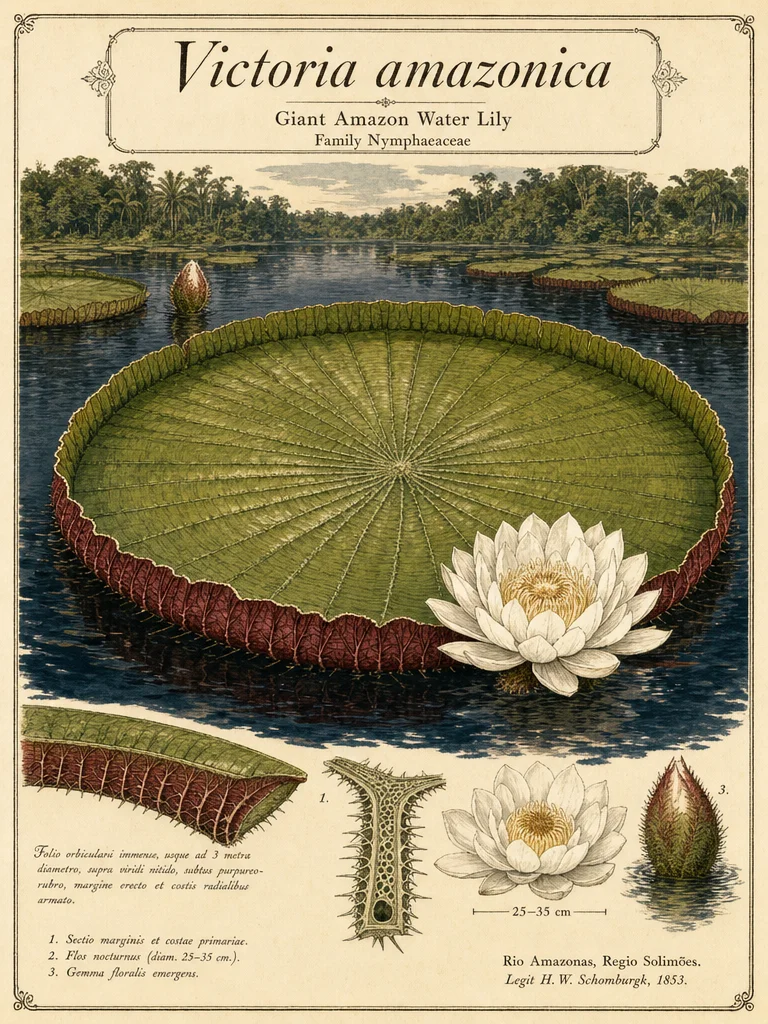
The leaves of Victoria amazonica are not just large. They are the largest floating leaves produced by any plant on Earth — circular pads up to 3 metres across, edged with an upturned burgundy rim, ribbed on the underside like the hull of a ship. A child can sit on one without sinking.
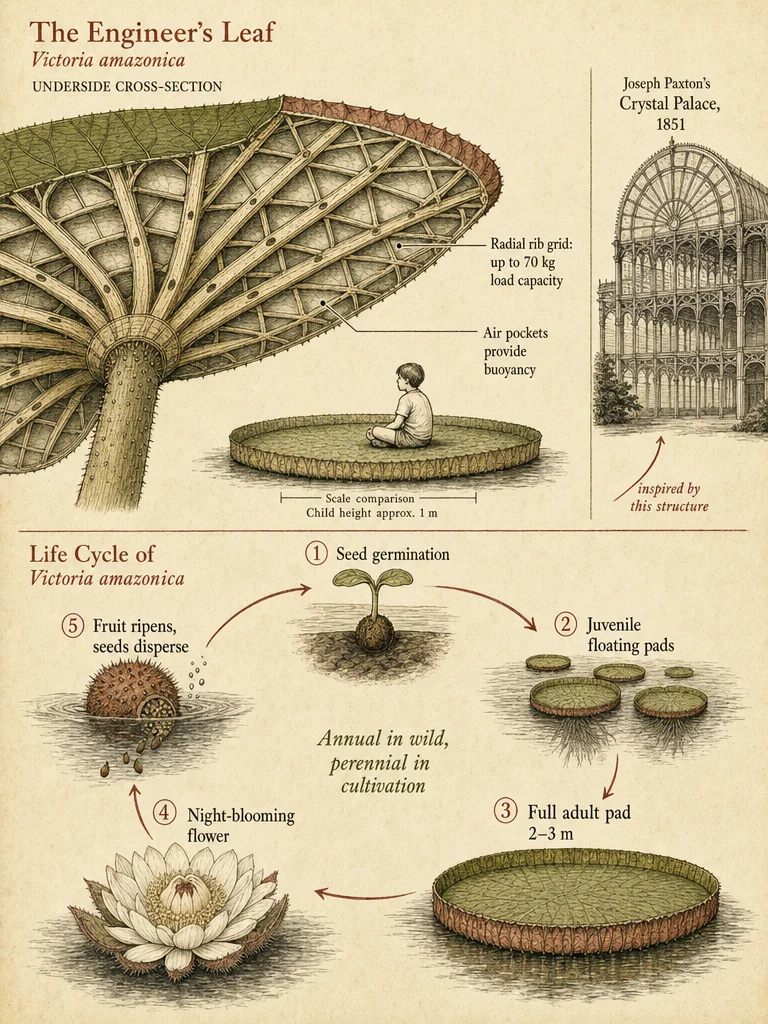
That structural fact matters beyond botany. In 1849, the English gardener and architect Joseph Paxton studied the leaf's underside in detail: a radial grid of thick primary ribs, braced by secondary cross-ribs, enclosing air-filled chambers that provide buoyancy and compression resistance simultaneously. He then applied the same principle to the iron-and-glass roof of the Crystal Palace for the 1851 Great Exhibition. The building that housed the first world's fair was, in its structural logic, a lily pad.
Flower and pollinator
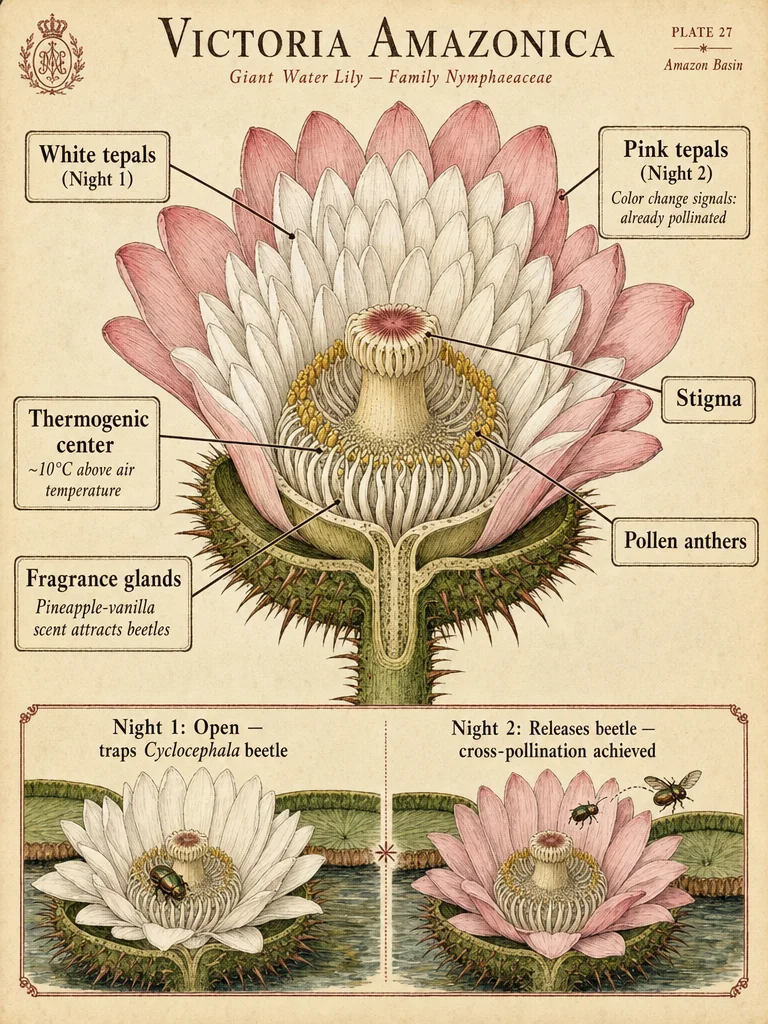
The flowers open at dusk. On the first night, each bloom is pure white — tightly cupped, about 25–35 cm across, producing a strong pineapple-vanilla fragrance and heating its inner chamber to roughly 10°C above the ambient air temperature. That combination of warmth and scent attracts scarab beetles of the genus Cyclocephala. They enter, and the petals close around them overnight. By morning, the beetles are dusted in pollen.
On the second night, the flower reopens — but now the petals have flushed pink to purple. The color change is a signal: this flower has already been pollinated. Beetles passing by that night bypass it in favor of fresh white blooms, carrying last night's pollen with them. The flower then sinks below the water surface to ripen its fruit. The entire performance lasts 48 hours.
The plant itself
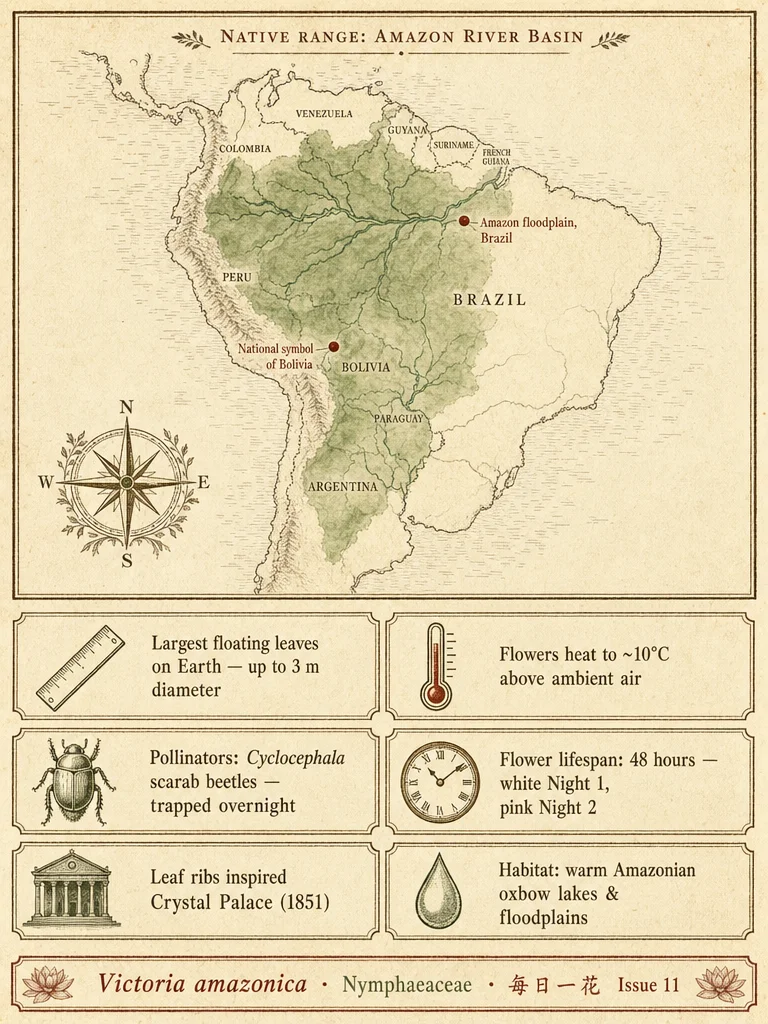
Victoria amazonica grows in the seasonally flooded lakes, oxbow pools, and slow river margins of the Amazon basin — across Brazil, Bolivia, Peru, Guyana, Paraguay, and northern Argentina. Water temperature between 25–35°C, full sun, shallow substrate. In the wild it behaves as an annual, regenerating from seed each rainy season. In cultivation (it is now grown in botanical gardens and tropical water gardens globally) it can persist as a perennial.
The seeds are eaten by Amazonian Indigenous peoples — roasted or ground into a coarse flour. The leaves were traditionally used as cradles for infants. In Bolivia, Victoria amazonica is the national flower.
The four images
Image 1 — Full specimen portrait. The adult pad seen from above: waxy green surface, radiating ribs, upturned burgundy rim, one white night-1 flower opening at the edge. The proportions of the leaf relative to the surrounding water convey the scale that a photograph alone struggles to capture.
Image 2 — Flower anatomy diagram. Cross-section of the flower with annotated callout lines: white and pink tepals, the thermogenic inner chamber (heated staminodes), fragrance glands, stigma, and pollen anthers. A small inset panel shows the two-night sequence: white / traps beetle → pink / releases beetle.
Image 3 — Engineering and life cycle. Upper section: cross-section of the leaf underside showing the radial rib grid and buoyancy chambers, with a note linking the structure to Paxton's Crystal Palace design. Lower section: five-stage circular life cycle — germination, juvenile pads, full adult pad, flowering, seed dispersal.
Image 4 — Range map and key facts. Outline map of South America with the Amazon basin drainage highlighted. Six fact chips below: leaf diameter record, thermogenesis temperature, pollinator identity, flower lifespan, the Crystal Palace connection, and native habitat type.
Scientific name: Victoria amazonica (Poepp.) J.C.Sowerby | Family: Nymphaeaceae | Native range: Amazon River basin, South America | Bloom: year-round in native range, flowers last 48 hours | Notable record: largest floating leaves of any plant on Earth (up to 3 m diameter)
댓글